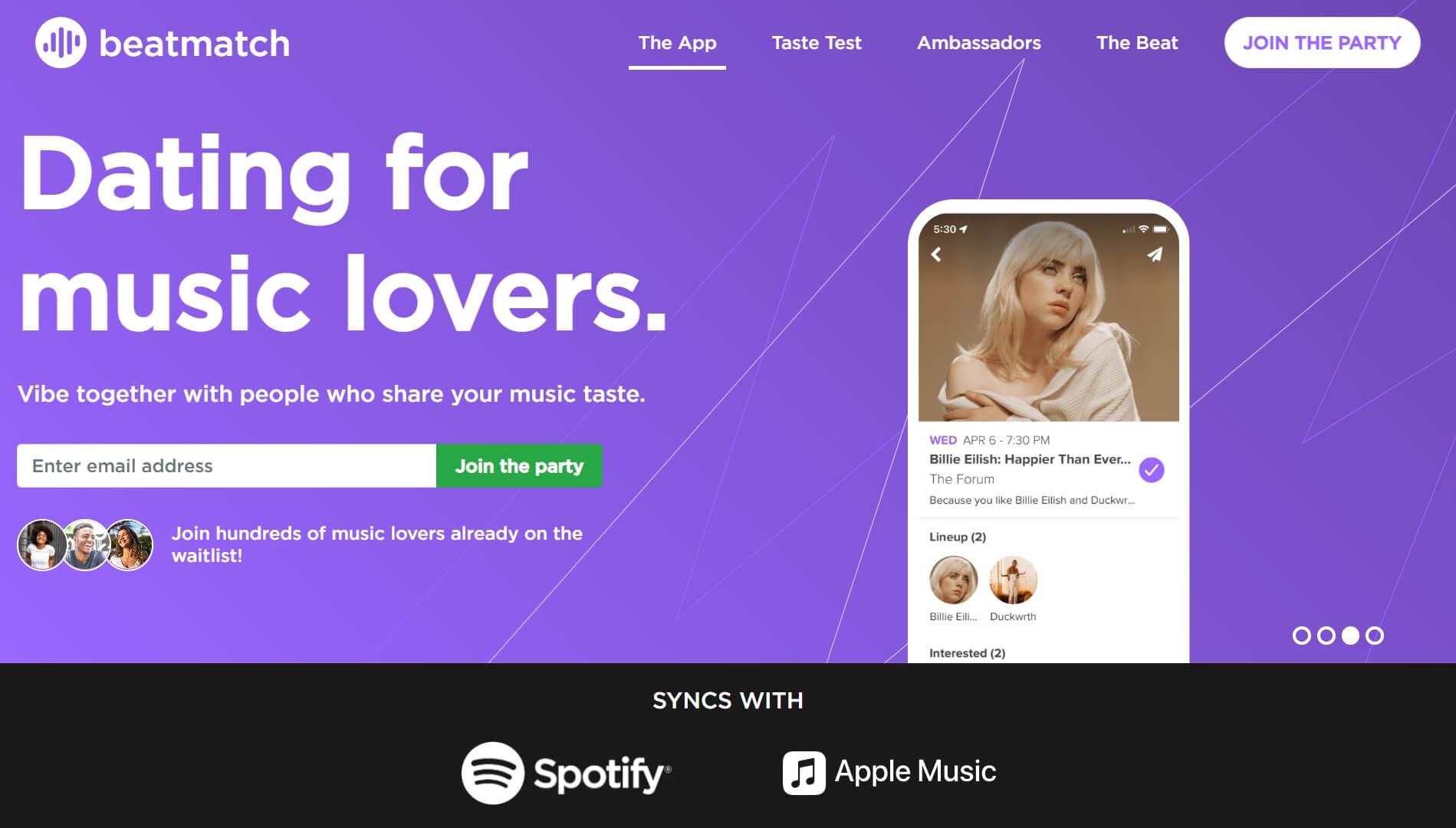
Beatmatch is a specialized social and dating app that links music enthusiasts according to their favorite artists and common listening habits.
Software developer and DJ Chudi Iregbulem established Beatmatch in 2021.
Iregbulem developed his technological skills in a number of significant digital and media firms, including Amazon, ESPN, and Caviar, before releasing the app.
After a pleasant encounter with a close friend at a concert, Iregbulem was motivated to develop the mobile matchmaking platform because they had similar specialized musical tastes.
By presenting itself as a social events platform that connects digital matching with in-person (IRL) experiences, Beatmatch sets itself apart from rivals.
Who Beatmatch Is Suited For
Beatmatch is best suited for Gen Z music lovers in big American cities who are tired of conventional dating apps and looking for more genuine, interest-based relationships.
Ideal User Profile
Active Music Fans: It is intended for people who see music as a “personality telltale” and wish to connect with others based on an emotional compatibility or “vibe” that they have in common based on their listening habits.
Attendees at Concerts and Festivals: Users that like in-person (IRL) gatherings are the target audience for this online dating app.
It is appropriate for those seeking “gig buddies” to go to local activities with as well as romantic relationships.
Major City Residents: Due to the concentration of users and event finding tools, it is currently most useful for people who live in or close to New York City, Los Angeles, and Seattle.
Spotify/Apple Music Users: Because the app matches users based on their “musical DNA” from streaming accounts, it is best suited for people who actively curate their digital music collections.
Who Beatmatch Isn’t Suited For
Beatmatch is a very specialized platform that is inappropriate for a number of user categories due to its limitations:
Users Not in the Main U.S. Hubs: Beatmatch isn’t yet appropriate for people who live in smaller cities or rural areas.
High user density and local event data, which are mostly concentrated in significant “music cities” like New York City, Los Angeles, and Seattle, are essential to the app’s basic operation.
Non-Streaming Listeners: The app is not appropriate for users who do not use Spotify or Apple Music because it matches people by analyzing “Musical DNA” through API integrations.
The algorithm cannot determine your compatibility or properly construct your profile if you solely listen to music on vinyl, CDs, or local files.
Mature Daters (Ages 35+): Although there isn’t a set age limit, Gen Z and younger Millennials are the app’s target audience due to its branding, “vibe-based” UI, and collaboration with university ambassadors.
The “social discovery” and “gig buddy” functions might not be as suitable for older users’ dating tastes.
Casual Music Listeners: The dating platform is intended for “superfans” and people who identify primarily with music.
You could find the matching criteria and prompts too exact or unimportant if music is merely background noise to you.
Users Looking for Long-Distance Relationships: Beatmatch is exclusively concerned with IRL (In Real Life) interactions.
The app’s focus on local concert ticketing and event planning will be detrimental if you are seeking long-distance partnerships or digital-only interactions.
Android Users: Although the app has expanded, users should confirm that it is now compatible because it has always focused its iOS experience and features for iPhone users.
Demographics and User Base of Beatmatch
The Beatmatch dating and social app’s user base is mostly focused on younger, “audio-first” generations and is heavily concentrated in particular urban areas.
Fundamental Demographics
Generation Z (Primary): Because Gen Z is highly responsive to meeting people online and spends a lot of time with digital audio, the internet dating app is specifically aimed at this generation, which is around 18 to 27 years old.
Audio-Centric Users: The average user is a “superfan” who expresses themselves mostly through music.
Compared to previous generations, Gen Z users are 25% more likely to favor audio-based social interactions.
Gender Trends: Gen Z women have demonstrated a greater desire to attend live concerts in the larger U.S. music scene.
This tendency directly supports Beatmatch’s gig buddy and event organizing services.
Geographic User Base
Beatmatch keeps a very localized approach, with the majority of its active users centered in three significant U.S. music hubs:
New York City
Los Angeles (the company’s headquarters)
Seattle
User Base Size and Growth
Niche Scale: Beatmatch is still a niche site with a few thousand active members, in contrast to mainstream behemoths like Tinder and Match.com, which have 75 million users.
Campus Presence: To ensure a high density of college-aged members in its target cities, the user base is strengthened by campus ambassador programs at major colleges (like NYU).
Creator Integration: The platform’s professional capabilities are used by artists and event planners to obtain loyalty statistics and demographic information on the people that attend their performances.
Key Characteristics of the Community
Streaming Platform Dependency: Because the app needs these integrations to create a user profile, the community is virtually entirely composed of Spotify and Apple Music subscribers.
Vibe-Based Matching: Users on the matchmaking site tend to engage with certain music-related cues such as “first round is on me if you listen to [Artist Name]” and value “musical compatibility” and shared “vibrations” over conventional swiping.
Registration Process on Beatmatch
Beatmatch’s registration process is a multi-step process that creates a profile based on your geography and musical identity.
Both iOS and Android users can access it.
1. Account Configuration
Basic Information: You begin by entering your name, phone number, and working email address.
Verification: To make sure the profile is authentic, standard dating app security usually includes a phone number verification code.
2. Music Integration (The “Musical DNA”)
Sync Streaming Accounts: Connecting to Apple Music or Spotify is a crucial step.
Persona Building: The online dating platform creates a “Beatmatch persona” by automatically analyzing your listening history.
Top songs, top artists, and top genres make up the three areas of this profile.
3. Profile Customization
Visuals: In accordance with normal dating app conventions, you must add a minimum of six images to your profile.
Musical Prompts: You respond to questions with songs or artists in place of typical text prompts.
“I put this on when I need to relax” and “I discovered this before anyone else” are two examples of prompts.
Location Settings: You choose the parameters of your search, such as your preferred gender, age range, and current city.
“Music hub” cities like New York City, Los Angeles, and Seattle are where the app is most popular.
4. Shift to Social & Events
Plan Creation: After registering, you can start making or participating in “Event Plans” right away.
Event Suggestions: The online matchmaking app makes tailored suggestions for nearby festivals, parties, and concerts based on your recently synchronized music data.
Design and Interface
To emulate the minimalist style of music players, Beatmatch purposefully departs from the crowded, text-heavy appearance of conventional dating apps, creating a “audio-first” social ecosystem.
Essential Components of the Interface
Minimalist “Vibe-Centric” Design: Using strong accent colors and dark-mode themes to create a “nightlife” vibe, the user interface heavily borrows from Spotify’s minimalist design.
Auditory UX: The “Musical DNA” soundtrack of each profile is played aloud as you browse through prospective matches, giving you a quick sensory “vibe check” prior to any contact.
Prompt-Integrated Layout: Instead of merely swiping on pictures, users interact by directly responding to music-related prompts (such as “The song I’d play for a first date is…”), much like the Hinge interface.
Feature-Specific Views
The “Social Feed”: A feed of “Plans,” social gatherings, and event schedules put up by locals based on your unique Spotify or Apple Music listening history, instead of a straightforward stack of profiles.
Beatmatch Posts: A special view for community engagement where users can join discussions about forthcoming concerts or festivals by attaching songs, performers, and GIFs.
Integrated Event Map: Users can view local events and concerts on a map using the interface’s discovery capabilities, and they can buy tickets right within the matchmaking dating app.
Design Philosophy
The design places a strong emphasis on “social wellness” by directing the user toward IRL (In Real Life) events rather than continuous scrolling.
The interface is designed to support both traditional one-on-one love matches and “low-pressure” group interactions (gig pals).
Pros of Beatmatch
Beatmatch is acknowledged as a “vibe-based” geosocial network that puts real-world interactions and genuine, music-driven connections ahead of the shallow “swiping” that characterizes popular dating apps.
Key Pros of Beatmatch
Authentic “Vibe” Matching: Beatmatch creates a “Beatmatch persona” by analyzing a user’s Spotify or Apple Music history, in contrast to standard dating apps where users evaluate mainly by photographs.
Through their musical preferences, this offers instant insight into a person’s personality and emotional condition.
Encourages Real-Life Meetups: The “Plans” tool, which enables users to find nearby festivals, concerts, and parties, is a notable feature.
The dating service allows users to purchase tickets directly, allowing for stress-free, music-focused first dates.
Friend-Finding “Gig Buddies”: The app has a social feed for locals to go to live music events with, so it’s not just for dating.
This makes it a tool for achieving “social wellness” by broadening one’s social network and eradicating loneliness.
Immersive User Profiles: These are auditory profiles that play music while you look at them.
As a result, music lovers can bond over common subcultures in a more “niche” and personal setting.
Features for Community Engagement: The internet dating platform launched “Beatmatch Posts,” which let users trade tickets, participate in discussions about forthcoming events, and post real-time updates with other attendees of the same performance.
Tools for Artists and Event Hosts: In addition to individual users, it offers professional tools for artists and event hosts to manage communities, advertise performances, and learn about the demographics of attendees.
Cons of Beatmatch
Beatmatch’s limited reach and significant reliance on technology are its main disadvantages as a social and dating platform.
1. Geographical Restrictions
Highly Concentrated: New York City, Los Angeles, and Seattle are the three main “music hubs” in the United States where the dating app is nearly entirely active.
Low Rural Utility: Because the platform’s “Real-Life” aspects are geared on urban nightlife, users outside of these particular metropolitan areas frequently discover no matches or pertinent local events.
2. Compulsory Streaming Integration
Limited Music Sources: Users must link to either Spotify or Apple Music to create a “Musical DNA” profile.
No Manual Curation: The automated matching process of the online dating service is now inaccessible to users that listen to music through local files, vinyl, or other services, such as Tidal or YouTube Music.
3. Smaller User Base
Niche Scale: With only a few thousand users, Beatmatch is still a minor site compared to more popular rivals like Hinge or Bumble.
As a result, you might keep seeing the same profiles.
Gen Z Specificity: Older populations looking for committed partnerships find it less appealing due to its branding and college ambassador programs.
4. Technical and Privacy Issues
API Vulnerability: Because the app is “beholden” to streaming service APIs, any disruptions in service or modifications to Spotify’s or Apple’s conditions can cause matching functionalities to be momentarily disabled.
Data Collection: It requires a lot of personal information, such as location and listening history, just like the majority of contemporary dating apps, which can cause some users to worry about their privacy.
5. Platform Evolution Fatigue
Feature Trend: The trend toward “social event planning” and “creator tools” can be overwhelming or distracting to some users seeking a conventional dating experience.
Matching System on Beatmatch
To promote both romantic and platonic relationships, Beatmatch’s matching method is a multi-layered process that blends automated data analysis with social event-based discovery.
1. Musical DNA Analysis
The system’s core component is an API interaction with Apple Music or Spotify.
Algorithmic Matching: To create a “Musical DNA” profile, the dating platform examines your current listening history, including popular musicians, popular genres, and particular songs.
Compatibility Scoring: Using similar musical tastes as a basis for profound personality compatibility, it then recommends local people whose listening preferences and “Beatmatch personas” coincide with your own.
2. Social & Event-Based Discovery
Beatmatch’s places more emphasis on event-driven matching than conventional “swipe” apps.
For Your Feed: The app makes recommendations for nearby concerts, festivals, and parties based on your musical data.
Event Plans: “Plans” for particular events can be created or joined by users.
This enables you to connect with others prior to the performance and see who else is interested in the same live experience.
Shared Intent: When two users express interest in the same event, matching frequently takes place, enabling “gig buddy” interactions that are less stressful than a typical date.
3. Interactive Profile Prompts
Additionally, music-focused suggestions that take the place of conventional text bios make matching on the matchmaking service easier.
Audio-First Interactions: By leaving comments on particular songs or artists listed on a prospective match’s profile, users can engage with them.
Auditory Vibe Check: The matching method enables an instant “vibe check” where users can hear the “soundtrack” of a potential match’s life before choosing to connect because profiles play music while they are browsed.
4. Friend vs. Date Modes
You will be able to filter your matched intent using the system:
Dating Mode: Conventional romantic matching based on age, gender, distance, and musical compatibility.
Social/Event Mode: Particularly for locating “event buddies” to go to shows with, putting a common interest in a particular lineup ahead of long-term romantic compatibility.
Free Features on Beatmatch
The main social and dating features of Beatmatch are still available for free download and use.
Unlike many popular competitors that apply paywalls for basic communication, Beatmatch provides its essential music-matching services to all members at no cost.
Core Free Features
Music Integration: You can create an automated “Beatmatch persona” and develop your “Musical DNA” by connecting your Spotify or Apple Music account for free.
Matching and Messaging: Based on similar musical tastes, you can match folks algorithmically and send free messages to your matches on the mobile dating app.
Event Discovery: Based on your music library, the “For You” feed offers free access and personalized suggestions for concerts, festivals, nightlife, and art exhibits.
Social Coordination: You can locate “gig buddies” in real time by creating and sharing event arrangements with friends or local users.
Community Engagement: Free features like Beatmatch Posts let you participate in discussions about forthcoming events, exchange tickets, and provide real-time information.
Private Chat: To facilitate coordination with other attendees without requiring a premium subscription, every event plan includes a private group chat.
Similar Free Music Tools
Users looking for “Beatmatch” can also come across distinct, free technical resources for producers and DJs:
Beatmatch.PRO: DJs can practice manual beatmatching techniques by ear, a free online game that doesn’t require a subscription or login.
Creative Software: Those who want to make music instead of just discover it can use free entry-level programs like Groovepad or MPC Beats.
Paid Features on Beatmatch
For its primary social functions, such matching based on musical taste and event discovery, the Beatmatch social and dating app retains a mostly free approach.
Beatmatch markets itself as a “social events platform” with paid features that are primarily targeted at event planners and people want to increase their social visibility, in contrast to many popular dating apps that need paid subscriptions so as to interact.
1. Paid Features for Individual Users
Beatmatch’s paid choices concentrate on boosting a user’s local visibility, even if specific tier titles, such as “Gold” or “Premium,” are typical in the industry:
Enhanced Visibility: Features to “boost” a profile or an event plan are sometimes included in paid services, guaranteeing that it appears at the top of the local “For You” feed for others in large hubs like NYC or LA.
Ad-Free Experience: A premium tier can eliminate sponsored event content or third-party advertisements that show up in the social stream, just like many specialty apps.
Advanced Social Tools: Certain premium versions of comparable apps let users know who has “liked” their musical identity prior to matching or send an infinite number of messages.
2. Paid Features for Creators and Organizers
For artists and event planners, Beatmatch offers a “Creator Suite” with expert tools:
Event Promotion: To reach a highly targeted community of local listeners with similar musical tastes, organizers can pay to start and advertise gatherings.
Community Management: Tools include the ability to send unlimited emails or SMS updates to individuals who have signed up for an event.
Audience Insights: Detailed demographic and “loyalty” statistics on the fans who attend their shows are provided by paid tiers for creators.
Cost of Beatmatch
Whether you are an event planner utilizing Beatmatch’s professional capabilities or an individual music enthusiast using it for social connections determines how much it costs.
Beatmatch Social & Dating App
The platform’s essential features are still free to download and utilize for the average user.
Individual Use: Standard features like messaging other users on the matchmaking dating platform, matching based on “Musical DNA,” and connecting Spotify or Apple Music are all free.
Social Coordination: Users can create and distribute free personal event “plans” (such as get-togethers for festivals or concerts).
Optional Premium: Although the social app is mostly free, associated creative tools under the “BeatMatch Studio” brand include premium tiers that range from $5.99 per month to $59.99 for lifetime access.
Beatmatch for Event Creators
Beatmatch uses a fee-based approach that is connected to ticket sales for professional organizers and musicians.
Free/RSVP Events: Organizing events that don’t charge admission is totally free.
Paid Ticket Fees: Orders for events that have a ticket price are subject to a processing cost of 10% + $0.99 per ticket, which is normally paid by the attendee.
Integrated Marketing Tools: Event planners now have access to professional services including custom branding, community management tools, and limitless SMS and email campaigns.
Customer Support
The Beatmatch dating and social app’s customer service is mainly managed online.
There isn’t much direct phone assistance for regular consumers.
How Beatmatch Support Can Be Reached
Email Support: Contact@beatmatch.app is the official team’s email address.
Website Contact Form: For direct questions, there is a “Contact Us” link on the official website, beatmatch.app.
Social & Community: The company periodically engages through its magazine section or social media profiles for informal assistance or comments.
Support for Event Creators
Within the mobile interface of the app, artists and organizers who use the “Creator Suite” to manage communities or sell tickets have access to specific management tools.
These individuals are typically given priority through the primary contact email for specific ticketing concerns or questions for rapid payout.
Verdict
Beatmatch is a highly specialized, “vibe-centric” platform that is perfect for Gen Z music superfans in major U.S. cities, but because of its tiny user base and geographical restrictions, it is not yet a viable mainstream replacement for matchmaking apps like Tinder or Hinge.
The Positive Verdict
Fighting “App Fatigue”: Beatmatch is praised for offering a “less surface-level” experience.
By emphasizing common musical preferences as a “personality telltale,” it enables users to transcend conventional small conversation and assessments based solely on appearance.
Bridge to Real Life: One of its most notable features is its capacity to link directly to local concert and festival tickets, thereby facilitating IRL (In Real Life) meetups.
It is especially commended for assisting users in finding “gig buddies” without the stress of a conventional date.
Immersive Experience: One of the most cutting-edge designs in the specialized dating market is the aural interface, which plays music from a user’s carefully chosen “Musical DNA” while you peruse their profile.
The Critical Verdict
Geographic Dead Zones: Anyone who isn’t in Seattle, Los Angeles, or New York City can’t use the dating app.
It flourishes in these “music hubs,” but there is insufficient traffic for reliable matching elsewhere.
Platform Identity Shift: Although it started off as a dating app, its transformation into a “social events platform” can irritate users hoping for a more conventional love encounter.
It currently divides its attention between event planners and daters.
Niche Restrictions: With just “several thousand users,” it doesn’t have the critical mass of popular websites like Match.com, which has 75 million users.
Final Recommendation
Use it if: You are a Gen Z music enthusiast in NYC, LA, or Seattle who prefers musical “vibrations” over typical swiping and wants to meet people expressly to go to live performances.
Avoid it if: You are searching for a busy dating pool, reside in a rural location, or don’t utilize Spotify or Apple Music.